
Dental Bridges: A Reliable Solution for Your Smile in Prague
What is a dental bridge and how does it work?
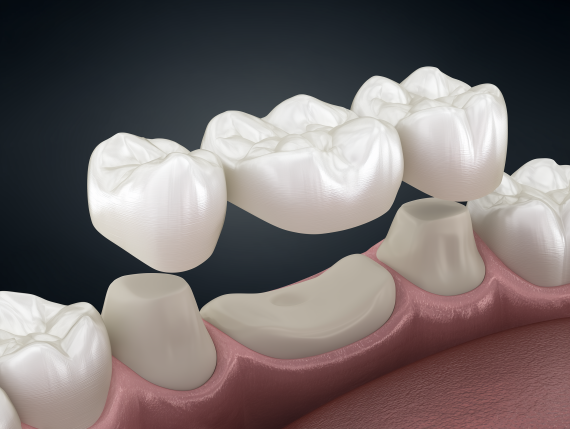
A dental bridge is a fixed (non-removable) dental prosthesis that serves to bridge the gap created by the loss of one or more teeth. As the name suggests, it works on the principle of a bridge – it rests on the teeth adjacent to the gap, which are called abutment teeth (or anchor teeth). Crowns are placed on these abutment teeth, which must be sufficiently strong and healthy. These crowns are firmly connected to the so-called anchor (or cusps), which are artificial teeth replacing the missing ones. The entire structure thus forms one solid unit that is permanently cemented to the prepared abutment teeth.
The result is not only the restoration of full functionality of the teeth (chewing, speaking), but also the restoration of the natural appearance of your smile. The bridge prevents the surrounding teeth from moving into the gap and protects the jawbone from further changes.
When is a dental bridge a suitable solution?
A dental bridge is an ideal choice in the following situations:
- You are missing one or more teeth in a row.
- The teeth adjacent to the gap (the abutment teeth) are sufficiently healthy, strong and have a good prognosis. These can be your natural teeth or dental implants.
- For example, abutment teeth already have larger fillings or are otherwise weakened and their grinding for a crown is still indicated.
- The patient prefers a fixed solution to a removable replacement (e.g. partial denture).
- The patient is not a suitable candidate for dental implants for some reason (e.g. health condition, lack of bone, financial reasons) or prefers a faster solution.
At the Dobrý Dent clinic, we will always carefully evaluate your specific situation, perform a thorough examination including modern diagnostics (e.g. 3D CBCT X-ray for detailed imaging of the bone and tooth roots) and propose the most suitable solution for you, taking into account your needs and wishes.
Types of dental bridges and materials used
There are several types of dental bridges, which differ in the anchoring method and materials used. The choice of a specific type depends on the location of the gap, the condition of the abutment teeth, and your aesthetic preferences.
By construction:
- Traditional (classic) bridge: The most common type. It consists of crowns placed on ground abutment teeth on both sides of the gap and a pontic (or more pontic) in the middle. It requires healthy and stable abutments.
- Cantilever (flying) bridge: It is used in cases where an abutment tooth is available on only one side of the gap. The crown is placed on one abutment tooth and the pontic “hangs” into the gap. This solution is not suitable for all situations, as it transfers more load to the abutment tooth, and is therefore used rather exceptionally, typically in the anterior part of the dentition.
- Adhesive (Maryland) bridge: This is a minimally invasive option. The pontic is attached to the adjacent teeth using small wings (metal or ceramic) that are glued to the inner (lingual/palatal) side of the abutment teeth. These teeth are ground only minimally or not at all. Adhesive bridges are more suitable for replacing a single tooth, especially in the anterior part of the mouth, and in patients with good bite conditions. Their lifespan may be shorter than that of traditional bridges.
By material:
Modern dentistry offers a wide range of materials that allow you to achieve excellent aesthetic and functional results:
- Metal-ceramic bridges: They have an internal structure (skeleton) made of a durable metal alloy (often a precious metal alloy or a chromium-cobalt alloy), which is covered with a layer of ceramic in the color of your teeth. They are very strong and durable, representing a proven solution with a good price-performance ratio. However, the metal structure can sometimes shine through the gum as a thin gray rim and does not transmit light like a natural tooth.
- All-ceramic bridges (e.g. zirconia): They are made entirely of ceramic materials, most often of highly strong and aesthetic zirconium dioxide (zirconium) or lithium disilicate. These bridges are biocompatible (do not irritate surrounding tissues), highly aesthetic (they perfectly imitate the appearance, color and translucency of natural teeth) and do not contain any metal. This makes them an ideal choice, especially for the visible part of the teeth. Zirconium bridges are also extremely strong and durable, suitable even for the back part of the teeth. At Dobrý Dent, we prefer modern all-ceramic solutions for their excellent aesthetics and biocompatibility.
How is a dental bridge made at Dobrý Dent?
At our clinic Dobrý Dent in Prague 5, we emphasize precision, quality and patient comfort at every step of the treatment. The process of making a dental bridge usually includes the following stages:
- Introductory consultation and examination: The doctor will discuss your expectations and possible solutions with you in detail. He will perform a thorough clinical examination of the teeth and gums. An essential part is an X-ray examination (intraoral images, panoramic OPG image, or 3D CBCT examination for a detailed assessment of the condition of the abutment teeth and bone). Based on all the information, he will make a diagnosis and propose an individual treatment plan.
- Preparation of abutment teeth (preparation): If the abutment teeth are healthy, they must be ground down so that the bridge crown can be placed on them. We perform this step with maximum care and precision, often using an operating microscope, which allows for multiple magnification of the working field and guarantees perfect preparation accuracy. The entire procedure is performed under local anesthesia. To ensure your maximum comfort, we use a modern computer-controlled anesthesia system STA (Single Tooth Anesthesia), which allows the anesthetic to be applied very slowly and specifically, ensuring a completely painless application and effect.
- Impression: After tooth preparation, it is necessary to make precise impressions of your teeth, which serve as a basis for the production of a bridge in a dental laboratory. At Dobrý Dent, we use a modern intraoral 3D scanner. This digital impression is much more comfortable for the patient than classic impressions using material in a spoon – it is faster, more accurate and eliminates the gag reflex. The digital data is immediately sent to the laboratory.
- Color selection: Together with your doctor, you will select the optimal shade of ceramic so that the bridge perfectly matches the color of your other teeth and looks as natural as possible.
- Preparation of a temporary bridge: Before the laboratory manufactures your definitive bridge (which usually takes several days to weeks), we will provide your ground teeth with a temporary bridge. This protects your teeth from damage and sensitivity, allows you to eat and speak normally and preserves the aesthetics of your smile.
- Manufacturing the definitive bridge: In a renowned dental laboratory, with which we have been cooperating for a long time, your individual bridge is precisely manufactured from the selected material (e.g. metal-ceramic or all-ceramic/zirconium) based on digital impressions.
- Installing and fixing the bridge: At your next visit, the doctor will remove the temporary bridge and try on the definitive one. He will carefully check its fit, bite, shape and color. If everything is in order and you are satisfied with the result, the bridge will be permanently attached (cemented) to the abutment teeth using a special dental cement.
- Final instructions: After the bridge is placed, we will provide you with detailed information on how to properly care for it so that it serves you for as long as possible.
Benefits of dental bridges
Dental bridges offer a number of benefits:
- Restoration of function: They fully replace the function of lost teeth, allowing for proper chewing and speaking.
- Excellent aesthetics: Modern materials, especially all-ceramics, perfectly imitate the appearance of natural teeth, thus restoring the beauty and self-confidence of your smile.
- Prevention of tooth displacement: By filling the gap, they prevent the displacement of surrounding and opposing teeth, thus maintaining the correct bite and stability of the dentition.
- Preservation of facial shape: Losing teeth can lead to changes in facial features. The bridge helps maintain the natural shape of the cheeks and lips.
- Durability: With proper care and regular check-ups, well-made bridges can last for many years (usually 10-15 years or more).
- Relatively fast solution: Compared to dental implants, the bridge making process is usually faster.
- Fixed solution: Unlike removable dentures, the bridge is firmly attached to the mouth, which ensures comfort and confidence while eating and speaking.
Why choose a dental bridge at Dobrý Dent?
The Dobrý Dent Clinic in Prague 5 (Anděl) is your guarantee of high-quality and modern dental care. Here are the reasons why you should entrust us with the manufacture of your dental bridge:
- Experience and expertise: Our team of experienced dentists has many years of experience in the field of prosthetics and is constantly educating themselves in the latest procedures. We have been operating since 2010.
- High-tech: We invest in the most modern equipment that allows us to work with maximum precision and care:
- Operating microscope: Ensures precise preparation of abutment teeth and perfect bridge seating.
- Computer-controlled STA anesthesia: Guarantees painless treatment.
- Intraoral 3D scanner: For comfortable and highly accurate digital impressions without unpleasant materials.
- 3D CBCT X-ray: Enables detailed diagnostics and planning for optimal results.
- Quality materials: We use only certified and biocompatible materials from renowned manufacturers, with an emphasis on all-ceramic solutions (zircon) for the best aesthetics and durability.
- Individual approach: We give each patient maximum care and attention. We listen to your needs and wishes and propose a tailor-made treatment plan.
- Comfort and pleasant environment: Our goal is for you to feel safe and comfortable with us. The modern and relaxing environment of our clinic contributes to the reduction of stress from dental treatment.
- Comprehensive care: We offer a wide range of dental services under one roof – from dental hygiene and prevention, through conservative dentistry, endodontics, to surgery and implantology.
- Convenient location: You can find us in the heart of Prague 5, at Jindřich Plachty 535/16, near the Anděl transport hub, with good access by public transport and car.
Dental bridge care
In order for your dental bridge to last as long as possible and remain in perfect condition, consistent oral hygiene is essential. In addition to regular brushing with a toothbrush and toothpaste twice a day, it is crucial to pay special attention to the area under the bridge and around the abutment teeth.
- Cleaning under the bridge: The spaces under the bridge, where food debris and plaque can accumulate, must be cleaned using special tools – so-called superfloss (special dental floss with a reinforced end) or interdental brushes of the appropriate size. Our dental hygienist or doctor will show you exactly how to use these tools correctly.
- Regular cleaning: Don’t forget to thoroughly clean all surfaces of the bridge and other teeth.
- Professional dental hygiene: Have regular (usually twice a year) professional teeth cleanings by a dental hygienist. She will remove tartar and plaque from hard-to-reach places and check the condition of the bridge and gums.
- Regular check-ups at the dentist: Go for preventive check-ups with your dentist (also usually twice a year). The doctor will check the condition of the bridge, abutment teeth and surrounding tissues and detect any problems in time.
With proper care, you can significantly extend the life of your dental bridge and maintain a healthy and beautiful smile for many years.
Alternatives to dental bridges
Although bridges are a proven solution, there are other options for replacing missing teeth:
- Dental implants: They are considered the most modern and physiological replacement for a lost tooth. An implant is a titanium screw inserted into the jawbone, which replaces the root of the tooth. A crown is then placed on top of it. The advantage is that it is not necessary to grind adjacent healthy teeth. Implantology is one of our specialties at Dobrý Dent.
- Removable partial dentures: They are a more economical option, but less comfortable and aesthetic. The replacement rests on the remaining teeth with clasps and the patient takes it out at night.
The choice of the most suitable solution always depends on the individual situation, which we will be happy to discuss with you during a consultation.