
Making a dental filling at Dobrý Dent: Quality and care in Prague 5
Why is a dental filling necessary? Understanding tooth decay
Tooth decay (Latin caries dentis) is an infectious disease of hard dental tissues – enamel and dentin. It is caused by the action of bacteria present in dental plaque, which metabolize sugars from food and produce acids. These acids gradually demineralize (dissolve) the surface of the tooth. Initially, it may be a small, barely visible white spot on the enamel, which may not yet hurt. However, if this process continues, the decay penetrates deeper into the dentin, which is softer, and the decay spreads more quickly there.
The consequences of untreated tooth decay can be:
- Tooth sensitivity: First to sweet, sour, cold or hot stimuli.
- Pain: Initially mild, later it can be intense and throbbing, especially when biting or at night.
- Pulp inflammation: If the decay penetrates to the nerve of the tooth, pulpitis occurs, which is often very painful and requires root canal treatment (endodontics).
- Infection of the surrounding tissues: The inflammation can spread to the bone around the root of the tooth (periodontitis), which can lead to formation of a cyst or abscess.
- Tooth fracture: A weakened tooth can easily break.
- Tooth loss: In advanced stages, when the tooth is too damaged, its extraction (pulling out) may be the only option.
- General health problems: Chronic inflammation in the mouth can negatively affect overall health, such as the cardiovascular system.
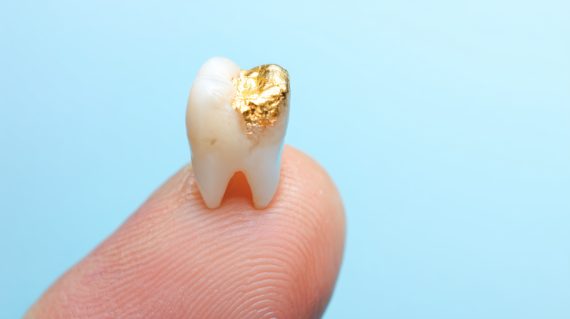
A dental filling (popularly called a „filling“) is a material with which a dentist replaces a part of a tooth damaged by decay. Its main purpose is:
- Stop the progression of caries: Removing infected tissue and hermetically sealing the space prevents further spread of bacteria.
- Restore tooth function: The filling restores the original shape of the tooth, which allows for proper biting and chewing.
- Restore aesthetics: Especially for front teeth, a natural appearance is important, which modern filling materials perfectly enable.
- Prevent further complications: Timely filling prevents pain, inflammation and the need for more complex and expensive treatments.
At Dobrý Dent, we place great emphasis on prevention and early diagnosis. Regular preventive examinations and dental hygiene are the key to preventing tooth decay. However, if a filling is already necessary, we are here for you with the best possible solution.
Types of dental fillings at Dobrý Dent: Modern and aesthetic solutions
The time when the only option was a dark amalgam filling is fortunately gone. At our clinic Dobrý Dent in Prague 5, we prefer modern, biocompatible and highly aesthetic materials that will not only reliably repair a damaged tooth, but also ensure the natural appearance of your smile. We mainly offer:
Photocomposite (white) fillings
Photocomposite resins are today the gold standard for most fillings, both in the front and back of the teeth. This is a tooth-colored material that consists of a resin matrix and inorganic fillers (e.g. glass or ceramic particles). It is applied in thin layers directly into the cleaned cavity (cavity opening) and each layer is cured with a special polymerization lamp (blue light).
Advantages of photocomposite fillings:
- Excellent aesthetics: Thanks to a wide range of shades and translucencies, we can perfectly imitate the natural color and appearance of your tooth. The filling is practically invisible.
- Adhesive bond: The composite is chemically bonded to the tooth using a special adhesive system. This means that the filling seals better and stays in place.
- Gentleness to dental tissues: Thanks to adhesive bond, it is not necessary to remove as much healthy tooth tissue as with amalgam. The preparation is minimally invasive.
- Immediate functionality: After curing with a lamp, the filling is immediately solid and the patient can eat and drink immediately.
- Biocompatibility: The material is well tolerated by the body and does not contain mercury.
- Repairability: Minor damage to a composite filling can often be easily repaired by adding another layer of material.
At Dobrý Dent, we use only high-quality photocomposite materials from renowned global manufacturers, which guarantee long life, color stability and wear resistance.
Ceramic fillings (Inlay/Onlay/Overlay)
For larger tooth defects, especially in the lateral area, where great emphasis is placed on resistance to chewing pressure, ceramic fillings of the inlay, onlay or overlay type are an excellent alternative. These fillings are not made directly in the patient’s mouth, but based on an accurate impression (classical or digital using our 3D intraoral scanner) in a dental laboratory or using CAD/CAM technology directly in the office.
Advantages of ceramic fillings:
- Maximum durability and longevity: Ceramic is a very strong and abrasion-resistant material that can withstand high chewing pressure. The lifespan is often longer than that of composite fillings.
- Perfect aesthetics and color stability: Ceramics perfectly imitate the appearance of natural enamel and do not change color over time.
- Precision: Thanks to laboratory or CAD/CAM fabrication, these fillings achieve excellent precision and marginal seal.
- Biocompatibility: Ceramics are fully biocompatible and non-irritating.
The fabrication of a ceramic filling usually requires two visits. During the first visit, the tooth is prepared, an impression or scan is taken, and the tooth is provided with a temporary filling. During the second visit, the finished ceramic filling is cemented (bonded) to the tooth.
Amalgam fillings (historical context)
Amalgam is an alloy of metals (mainly silver, tin, copper and mercury) that was widely used in the past for its durability and low cost. However, at Dobrý Dent, we prefer more modern and aesthetic materials. Amalgam fillings have several disadvantages:
- Unaesthetic appearance: They have a dark, metallic color.
- Mercury content: Although mercury is bound in amalgam, there are concerns about its possible release into the body.
- Need for more preparation: Amalgam does not hold on to the tooth adhesively, but mechanically, which requires the removal of a larger amount of healthy tooth tissue to ensure retention.
- Microcracks: Amalgam can corrode over time and microcracks can form at the interface between the filling and the tooth, through which bacteria can penetrate.
- Thermal conductivity: Can cause sensitivity to thermal stimuli.
For these reasons, amalgam fillings are actively We do not offer and recommend safer and more aesthetic alternatives to our patients. If you have old amalgam fillings and are thinking about replacing them, we will be happy to advise you and offer a suitable solution.
How is the filling made in our office in Prague 5? Precision and comfort
At Dobrý Dent, we understand that visiting the dentist can be a source of anxiety for some people. That is why we have designed the entire treatment process to be as pleasant, effective and, above all, painless for you. The dental filling is made in the following steps:
- Initial examination and diagnostics:
- First, we will conduct a thorough examination of your teeth and gums.
- To identify hidden cavities or assess their extent, we use not only visual inspection, but also modern diagnostic methods such as intraoral X-rays (IOR) or, if necessary, 3D CBCT X-ray. This device provides us with a detailed three-dimensional image of the teeth and surrounding structures, which is invaluable for accurate planning.
- We will discuss the findings with you and suggest the most suitable type of filling, taking into account the extent of the decay, the location of the tooth and your preferences.
- Local anesthesia for painless treatment:
- The key to comfortable treatment is perfect anesthesia. At Dobrý Dent, we use a modern computer-controlled local anesthesia system STA (Single Tooth Anesthesia System).
- This system allows the anesthetic to be applied very slowly and in a controlled manner, which minimizes the discomfort during the injection. The anesthesia is targeted only to the tooth being treated, so you do not feel any unpleasant numbness of the lip, tongue or cheek. The treatment is truly painless.
- Removal of tooth decay with maximum precision:
- After anesthesia, we proceed to remove all infected tooth tissue.
- To ensure maximum precision and gentleness, we work under magnification using an operating microscope. The microscope allows us to see even the smallest details, remove only the necessary amount of tissue and thoroughly clean the cavity, which is essential for the long-term success of the filling.
- We use modern rotary instruments with cooling that are gentle on the tooth.
- Cavity preparation and filling application:
- After removing the decay, we carefully clean, disinfect and prepare the cavity for the selected type of filling.
- For photocomposite fillings, we apply an adhesive system (so-called bond) that ensures a chemical bond between the tooth and the filling.
- The composite material itself is applied in thin layers, each layer being carefully adapted to the walls of the cavity and cured with a polymerization lamp. This procedure minimizes material tension and ensures a perfect seal.
- Shaping and polishing the filling:
- After applying the last layer, we carefully shape the filling so that it imitates the original anatomy of the tooth as closely as possible (cusps, grooves). This is important for proper function when biting.
- Then we polish the filling perfectly to a high shine. The smooth surface not only looks aesthetically pleasing, but also prevents plaque from settling and reduces the risk of new caries at the edge of the filling.
- Bite check:
- Finally, we check whether the filling does not interfere with the bite. Using special articulation paper, we identify any premature contacts and gently adjust them. A proper bite is essential for patient comfort and the prevention of temporomandibular joint problems.
The entire process of making one filling usually takes 30 to 90 minutes, depending on the extent of the decay and the type of filling. Thanks to our equipment and experience, we strive to make the procedure as effective and comfortable as possible.
Benefits of treatment at Dobrý Dent: Why choose us?
Choosing the right dental clinic is an important decision. At Dobrý Dent in Prague 5 (Anděl), we offer you a combination of experience, modern technology and an individual approach that guarantees the best possible care for your smile.
- Experienced and empathetic team: Our clinic has been operating since 2010. Our team consists of experienced dentists, dental hygienists and assistants who regularly train in the latest procedures and technologies. We understand that each patient is unique and we approach you with empathy and understanding.
- Leading technologies for your care: We invest in the most modern equipment that allows us to provide precise, effective and comfortable treatment:
- Operating microscope: Ensures maximum precision in removing decay and making fillings.
- Computer-controlled anesthesia STA: For truly painless treatment without the unpleasant feeling of numbness of the surrounding tissues.
- Digital X-ray (RVG) and 3D CBCT: For detailed and accurate diagnostics with minimal radiation exposure.
- 3D intraoral scanner: For comfortable and highly accurate digital impressions without the need for the use of classic impression materials (e.g. for ceramic fillings).
- High-quality and proven materials: We use only certified, biocompatible and highly aesthetic materials from leading global manufacturers, which guarantee long life and natural appearance of your fillings.
- Painlessness and comfort: Your comfort is our priority. In addition to painless STA anesthesia, we take care of the pleasant and calm environment of our modernly equipped clinic.
- Individual approach: We will always discuss your condition and treatment options with you in detail and together we will choose the best solution for your needs and wishes.
- Comprehensive dental care: In addition to fillings, we offer a wide range of other services – from dental hygiene and teeth whitening, to endodontics (root canal treatment), prosthetics (crowns, bridges), periodontology (treatment of gum disease) to dental implants. All under one roof.
- Convenient location: You can find us in modern premises at Jindřicha Plachty 535/16, Prague 5 – Smíchov, near the Anděl transport hub, with good access by public transport and car.
Caring for dental fillings and preventing further decay
To ensure that your new dental fillings last as long as possible and to prevent further cavities, proper oral care and regular visits to your dentist and dental hygienist are important.
- Thorough oral hygiene: Brush your teeth at least twice a day with a quality toothbrush (soft or medium-hard) and fluoride toothpaste. Don’t forget about the spaces between your teeth – use interdental brushes or dental floss daily. It is in the spaces between your teeth that hidden cavities often develop.
- Regular preventive check-ups: Visit our Dobrý Dent clinic for preventive check-ups twice a year. We will detect any potential problems in time and prevent their development.
- Professional dental hygiene: Perform regular (usually 1-2 times a year, as recommended) dental hygiene. Professional removal of tartar and plaque is key to gum health and the prevention of caries and periodontitis. Our dental hygienists will also advise you on cleaning techniques and choosing suitable tools.
- Limit sweet and sour foods and drinks: Sugars are the main food for bacteria that cause caries. Acids (e.g. in citrus fruits, juices, carbonated drinks) directly etch the enamel. Limit their consumption, especially between main meals.
- Fluoridation: Using fluoride toothpastes and possibly mouthwashes strengthens tooth enamel and makes it more resistant to acids. In some cases, we can also recommend professional fluoridation in the office.
Remember that even the highest quality filling has a lifespan that depends on many factors (filling size, material, oral hygiene, eating habits, bite conditions). During regular check-ups, we monitor the condition of your fillings and, if necessary, recommend their repair or replacement.
Frequently Asked Questions (FAQ) about dental fillings
- Is dental filling painful?
- At Dobrý Dent we use modern methods of anesthesia, especially computer-controlled STA anesthesia, which ensures that the procedure itself is completely painless. You may feel slight sensitivity after the anesthesia wears off, but it usually disappears quickly. If necessary, we will recommend appropriate analgesics.
- How long does a dental filling last?
- The lifespan of a filling depends on many factors: the type of material (ceramic fillings usually last longer than composite), the size of the filling, the location of the tooth, the level of your oral hygiene and eating habits. A high-quality photocomposite filling can last 5-10 years or more, ceramic inlay/onlay often 10-15 years or more. Regular check-ups will help extend their lifespan.
- Is a white (photocomposite) filling also suitable for back teeth?
- Yes, modern photocomposite materials are strong and durable enough to be used on molars, where there is greater chewing pressure. For very extensive defects, a ceramic onlay may be more suitable, but for common and medium-sized cavities, photocomposite is an excellent and aesthetic choice even at the back.
- Can the tooth under the filling hurt?
- Shortly after the filling is made, the tooth may be slightly sensitive to bite or thermal stimuli, which is usually temporary. If the pain persists, is intense, throbs or appears over time, this may signal a problem (e.g. too high a filling, pulpitis). In such a case, do not hesitate to contact us.
- Does a white filling change color over time?
- Modern high-quality photocomposite materials are relatively color-stable. Slight surface discoloration can occur due to smoking, drinking coffee, tea or red wine. This discoloration can often be removed during dental hygiene. Ceramic fillings are more resistant to discoloration.
- How much does a dental filling cost at Dobrý Dent?
- The price of a dental filling depends on its size (the number of tooth surfaces it affects), the material used (photocomposite, ceramic) and the complexity of the procedure. We will tell you the exact price after the initial examination and drawing up of a treatment plan. Investing in a quality filling is an investment in your health and the prevention of future problems.
- Is it necessary to replace old amalgam fillings?
- If an amalgam filling is functional, seals well and there are no signs of decay or cracks underneath, there is no need to replace it unnecessarily. Reasons for replacement may be aesthetic, concerns about mercury content, or if the filling is no longer leaking, cracked or has secondary decay underneath. We will be happy to assess the condition of your existing fillings and recommend the best course of action.